
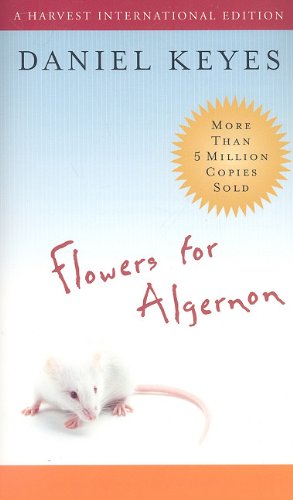
Have you ever read the book Flowers of Algernon? This story always comes to mind when I think about knowledge, particularly the extent to which it is a blessing or a curse. In brief, the novel by Daniel Keyes follows a character named Charlie who is developmentally disabled and part of a controversial surgical procedure intended to enhance his mental abilities. The only other test subject with seemingly positive results was a rat named Algernon. Throughout the book, Charlie goes from being a simple-minded charismatic young lad who sees the beauty in little things to more of a cynical, knowledge-craving academic. He becomes well aware that he grew beyond the intelligence level of even the most prestigious academics, and he describes most of them as phonies with useless research. He comes to a realization that people we consider “intelligent” often merely have a larger vocabulary than the average population, which creates a great disconnect between the educated and uneducated populations. He also begins to realize that the people he considered his friends while he had his disability were in fact mocking him and not the friends he had imagined. Though, he eventually loses his intelligence as quickly as he gained it, and all that is left of his insight are his “progress reports” detailing his experiences. It’s a bittersweet tale of an evolved perspective, but was an increase in knowledge a good thing for Charlie?
I do think Flowers of Algernon conveys some great truths: Yes, the academic world struggles with reaching a non-literature-prone audience, and often a lot of data is interpreted incorrectly or generalized by mainstream media outlets. Many scholars are also guilty of publication bias, meaning that they will create studies that are most likely to get funding or published, not necessarily because the study is invaluable to society. Academia as a whole can become a dangerous game and a dangerous cycle filled with self-seeking individuals who wish to create successful careers and receive tenure early/be rewarded with less responsibilities. I’m well aware of the controversy; I witness it daily.
Though, I do think it’s important to recognize that knowledge, when sought for out of curiosity with noble intentions is a beautiful thing. It helps one to learn more about people and the world we share. It isn’t something one should fear, especially when certain results counter someone’s life-work because they failed to control for a particular variable or examine a phenomenon in a new context. Researchers with integrity understand this notion of knowledge. Those who authentically pursue it are not narrow-minded. They question everything at face-value, and they dig deeper, analyzing everything about a study or article from the biases of the author, the credibility of the data collection methods, the accuracy of statistical analyses, etc. Their beliefs are grounded with what they find to be the most compelling evidence, and they are subject to change at any moment with newly arising data.
Knowledge as Power
Whether or not knowledge is power is a very popular debate. When examining it from a sociological standpoint, there appears to be a vast majority who believe knowledge to be the one thing that gives someone an edge in life over another. On Debate.org, arguments range in favor of knowledge not allowing one to be taken advantage-of or deceived to knowledge as a necessary tool for any form of man-made advancement. Though, those opposed to this notion of knowledge argue that if one were to acquire all knowledge, there would be no purpose to life or need to learn. They also argue that rewarding someone who appears to have more knowledge with more power (i.e. more responsibility or privileges) has nothing to do with their intelligence, only that they are better at wooing others. There are also many intelligent individuals in impoverished countries or even in the U.S. who have the capacity for great knowledge but are not given ample opportunities to apply themselves.
You get the idea, but there are dozens of more philosophical arguments about this idea. I’ve always been under the impression that it isn’t really what you know it’s who you know with regard to the job-world. Though, I do believe knowledge is a gift and someone who possesses it should be entitled to use one’s gifts for the betterment of mankind, not to self-seek or rise in one’s own reign of power.
The Tree of Knowledge of Good and Evil

The biblical story of Adam and Eve is notorious for it’s portrayal of the fall of man. It is often used to explain why death exists, why suffering exists, and why sin exists in the world today (See Born Good or Evil?). Essentially, God created the world, and he explicitly told his favorite creatures, who were made in his image and likeness, that they could enjoy anything in the garden except eat from the fruit of the Tree of Knowledge.
“Now the serpent was more crafty than any of the wild animals the Lord God had made. He said to the woman, ‘Did God really say, You must not eat from any tree in the garden?’
The woman said to the serpent, ‘We may eat fruit from the trees in the garden,’ but God did say, You must not eat fruit from the tree that is in the middle of the garden, and you must not touch it, or you will die.’
‘You will not certainly die,’ the serpent said to the woman. ‘For God knows that when you eat from it your eyes will be opened, and you will be like God, knowing good and evil.'”
Genesis 3: 1-4
Before the fall, Christianity teaches that humanity was in a state of original innocence. If you are unfamiliar with this concept, I highly recommend watching the below lecture about it, or reading the post I linked earlier in this section about this state versus that human beings are born-in today. Even if you are familiar with it, I think that the presenter below portrays this idea quite nicely and in a unique manner given the state of the world today.
“And I will put enmity
Genesis 3: 15-16
between you and the woman,
and between your offspring and hers;
he will crush your head,
and you will strike his heel.
To the woman he said,
‘I will make your pains in childbearing very severe;
with painful labor you will give birth to children.
Your desire will be for your husband,
and he will rule over you.’”
Above are some of the many consequences outlined by God after Adam and Eve freely chose to disobey him, to give-in to Satan’s temptation, and to be “like-God” knowing both good and evil instead of being content with the world of goodness they experienced in Eden. Though, it was not the knowledge that God was condemning. It was the freely-chosen act of disobedience. The knowledge of good and evil was something God intended to protect His people from, to preserve them from the need for salvation, though He still gave them the choice to pursue it themselves and did not intervene when they chose to do so. Funny how free-will works.
Knowledge as a Gift
Knowledge is not only a Gift of the Holy Spirit, but it also exists as a charism in another form (See Vital tools “missing” in Christian Evangelization). Both are good, both are graces, and both are gifts given by God to serve different purposes. A gift of the Holy Spirit is a spiritual gift given at Baptism and strengthened/sealed at Confirmation in order to help Christians deal with the spiritual warfare. It is intended to transform an individual. A charism is given to an individual not necessarily for his own use, but to be used for the transformation of others or for the good of the Church. Charisms can be either supernatural or natural. I can attest to the fact that they are very real, even those that seem to be the craziest. If you’re ever curious about them, reach out to the e-mail listed in my home-page. I can give you an earful of personal testimonies.
Anyways, here’s a brief distinction between the gift and charism of knowledge:
- Knowledge, the Gift: A deep trust and sureness about the Lord. This gift can be grown through studying scripture and Church teachings; it helps an individual embrace the truths of faith
- Knowledge, the Charism: Gift of insight/revelation; a supernatural revelation of facts past, present, or future which one did not learn through the efforts of the natural mind – not to be confused with the knowledge through study or one’s own experiences. This knowledge is a supernaturally imparted Word. It starts with knowing God personally. (Jesus and the disciples received many ‘words of knowledge’ from the Holy Spirit. See John 4:17-27, Matthew 17:27, Mark 5:36-40, Acts 5:1-9, Acts 3:1-10)
Does this mean that if you aren’t a water-baptized Christian, you can’t have knowledge?
Haha no. Knowledge is something that can be freely given to anyone, and people can pursue it without having been baptized. There’s technically 3 different modes of baptism that exist in the traditional Christian faith, though, that aren’t necessarily advertised in Protestantism. For example, baptism can occur simply through the desire to know the full truth. Thus, the pursuit of knowledge about the world and subsequently about God’s people, creation, and nature has the potential for someone to meet this baptismal requirement. As human beings, we are automatically equipped with reason, but not knowledge, which has to be taught or divinely inspired.
Why are we content with the “knowledge” we have now?
We should all constantly try to learn more, recognizing that we cannot possibly know everything. It is a certain degree of maturity in which one is able to fully-admit when one lacks knowledge and also recognizes that this it is “okay” to not know something.
If everyone was more like this, and every “argument” was more like an intellectual conversation/discussion like the one above – The world would be a much better place, truly open to hearing opposing thoughts and perhaps this study (Yaden et al., 2018) would not ring as true as it does today. Perhaps people would be less inclined to attack one another’s characters when they reach disagreement. Perhaps people would be more open to learning and less defensive about opposing views.
There is always more to learn; why limit yourself to the knowledge you have? This is intentionally choosing ignorance, don’t you think?
This doesn’t mean that you have to go and expose yourself to every thought known to man, especially if it violates your own values, but I ask you to then dive deeper into your own metacognition and study something new. Read a new book, or read the same book with a new lens.

There’s a beautiful quote about how one can read the same book multiple times, but at different times in life, one can always take-away a novel idea or a new meaning from it.
Incredible Knowledge is not a Necessity:
Therese of Liseux (1873-1897)
“Miss no single opportunity of making some small sacrifice, here by a smiling look, there by a kindly word; always doing the smallest right and doing it all for love.”
Therese of Lisieux
The life of Therese of “The Little Flower” is the perfect example for why big words and high-end intellectual knowledge are not necessary to believe-in or to know God. This young woman is known in the Church for her emphasis on the path to knowing God and happiness through the small things of everyday life. In her autobiography, she describes a decline in her personality in her mother’s death until she experiences a vision of the Child Jesus that transforms her. She left home to become a Carmelite nun at 15. She viewed knowledge and being an intellectual as an incredible gift that many are blessed with, but she recognized that not all are given the same degree of this gift. She, like many others, admitted to not understanding some of the academic arguments or spiritual treatises in existences at the time. She found beauty in simplicity, and she created such an impact on those around her that after her death, instead of waiting the required 50 years to canonize someone, the pope declared her sainthood after only 26.
“Sometimes, when I read spiritual treatises, in which perfection is shown with a thousand obstacles in the way and a host of illusions round about it, my poor little mind soon grows weary, I close the learned book, which leaves my head splitting and my heart parched, and I take the Holy Scriptures. Then all seems luminous, a single word opens up infinite horizons to my soul, perfection seems easy; I see that it is enough to realize one’s nothingness, and give oneself wholly, like a child, into the arms of the good God. Leaving to great souls, great minds, the fine books I cannot understand, I rejoice to be little because ‘only children, and those who are like them, will be admitted to the heavenly banquet.’”
St. Therese of Liseux
When Lack of Knowledge (Ignorance) Causes Corruption: Covington Catholic Conspiracy
Some of you are probably very familiar with the story of Covington Catholic in mid-January of this year. As a regular attendee of this particular march when I was this age, I was astounded to see how far-off from the truth this story escalated and how many of my peers as well as respected professors were so quick to judge based upon a simple image, a short-clip, and a caption. Now, we’re all guilty of buying-into “fake-news” (yes, I said it, but in this case it is well documented as such) at some point in our lives. Though, I was surprised as well as disappointed in how many intellectuals also fell into Twitter’s trap.
For those of you unfamiliar with this story, a multitude of clips similar to to this one as well as an image similar to the one below circulated the Internet, particularly Twitter, with hateful captions of white supremacy and claims of students mocking the Native Americans present. The media and general public wasted no time, and they twisted the story into something it wasn’t, with claims as far-fetched as the boys having approached the Native Americans while wearing their MAGA (Make America Great Again) hats (which I know for a fact are frequently sold on the street or passed out for free during this particular march) in order to push their own political agendas and support white supremacy.
It didn’t take long for interviews of the Native American man to follow or for the Internet to portray him as the victim of the entire situation. Many false posts claimed that he was a war-hero, and he himself claimed that his intention was to reduce the political tension of the mob-mentality of the young high school boys, who were in fact, simply chanting school cheers while waiting for their bus far outside of where the march occurred.
Apologies followed on behalf of the entire diocese the high school resided in before the incident was even properly investigated. Many people took the situation at face-value as it was portrayed by the media rather than conducting additional research, and countless others, even Catholics, stated that the boys’ behaviors were not acceptable.

Personally, I remember viewing one Tweet after another, condemning these high school boys, but I could never understand why. I don’t know if it is just that I am innately a skeptic and I don’t believe everything I see without doing more research into-it, but I never once thought at first-glance that the boys had done anything wrong, even after watching the short-clip with “proof” that was trending. I remember viewing multiple posts that encouraged others to call the boy’s school and even his home, and as a result, several hundred did. They sent hateful messages and threats to the kid for doing nothing other than standing there as a Native American man approached him and his friends after spouting hatred sayings about white people. I decided to do more research into the incident, and I found not only posts from his brother about all of the hate the young man in the circulating photo was receiving, but I also came across a less popular, full-video that directly contrasted the circulating claims of the Native American. Nathan Phillips claimed that the kids were cheering “Build that Wall,” though this cannot be heard once in the hour-long video of the account.
I found it oddly ironic that almost all major-news articles that were posted before the official press release of this full-video have since been edited to acknowledge the controversy. I can hardly find any of the original articles (this link captures many of their initial quotes) that were claiming that the kids were “horribly raised” and “racists.” I did, however, find the initial interview of the Native American man and his claims, as well as his interview after the aftermath of the incident.
More Resources: I Failed the Covington Catholic Test, BuzzFeed’s Fake News and Update
Knowledge is indeed a gift, for those without it who were content with living in ignorance and believing the words given to them at face-value really lost a lot of credibility after the Covington Catholic incident. Sadly, this is not the only time people have been misquoted or reputations have been ruined as a result of a series of false claims. It happens daily. As human beings, we have an obligation to seek the fullness of truth and to not be content with our current state of knowledge. The entire reason my website is titled the Beginning of an “Amaranthine Journey” is because the path of the pursuit of knowledge and the fullness of truth does does not have an end-point. Learning is supposed to be a life-long process.
Why are some of us so content with ignorance and accepting what we are told at face-value? And forwarding it to others without full-understanding?
What about those who are found guilty?
Does this knowledge have a right to be shared?
I’d say, yes – depending on the intent. Knowledge has a right to be shared. Though, there’s a difference between knowledge for the sake of knowledge and sharing knowledge for the sake of harming one’s reputation. This is defined as gossip, or in even graver instances as detraction or calumny.
“Respect for the reputation of persons forbids every attitude and word likely to cause them unjust injury. He becomes guilty:
CCC 2477
– of rash judgment who, even tacitly, assumes as true, without sufficient foundation, the moral fault of a neighbor;
– of detraction who, without objectively valid reason, discloses another’s faults and failings to persons who did not know them;
– of calumny who, by remarks contrary to the truth, harms the reputation of others and gives occasion for false judgments concerning them”
Remember Monica Lewinsky?
She was “Patient-0” of the unprecedented judgement and hatred that can stem from misuse of un-consented knowledge shared on the Internet with the intent to ridicule or harm. She acknowledges that her story had a right to be shared, and she admits her wrongdoings. Though, she emphasizes that people did not have a right to tear apart her humanity or any other person similarly humiliated online. Knowledge is a virtue, but how people decide to act in response to knowledge is where morality and ethics need to come into play. She mentioned the dangers of people who make monetary profits off of such stories shared online with the intent to humiliate and destroy reputations. It’s a dangerous cycle, particularly because they more they are shared, the more individuals seek-out to humiliate others for personal gain.
In Summary…
Knowledge is a gift, but it can easily be distorted and misused by those who claim to profess it for the sake of a “greater good.” Reflect upon your intentions before you share. The ends do not justify the means of vile behavior, meaning that even if one shares knowledge with intent to humiliate or judge another and it caused no direct harm to a targeted individual, the action isn’t justified. It’s still wrong. Just think before you speak, and even better: Think before you share.
Don’t limit yourself…Not in the world, and not in knowledge about the next.
Also, side note: agnosticism is less about belief and more about knowledge, or a lack thereof. It focuses on God being unknowable, if He exists, and this is completely true — at least through a physical means. However, theists believe that if man is open to the grace of God and receiving faith, he can come to “full-certainty” or “knowledge” of God’s existence.
 LG❥
LG❥


 Pursuit of Truth