
“There are not over a 100 people in the U.S. that hate the Catholic Church, there are millions however, who hate what they wrongly believe to be the Catholic Church. Which is, of course, quite a different thing.”
Fulton J. Sheen
Brief Overview
The Roman Catholic Church is considered to be the closest Christian tradition to original notion of Christianity outlined by Church Fathers, and its origins can be traced over 2000 years. It is Trinitarian, believing in one God, but 3 distinct persons. Its beliefs stem from both scripture and Tradition, and it is guided by the Magisterium, or the teaching authority of the Church. (History, Overview)
Beliefs
Worldview
- Multiple languages may be used in scripture and services
- The material world is viewed as a gift, and not something we are entitled to
- Catholicism believes in a single fullness of truth revealed to mankind by God in Scripture, Sacred Tradition, and through reason.
- Divine Revelation, Scripture and Tradition
- Catholicism believes in science + religion, not science vs religion
- Physics is the language in which God writes the universe
- Harmonious relationship: Science can supplement faith, and faith can supplement science
- The Church is not afraid of scientific discovery, only of men choosing to play God (i.e. contraceptives, eugenics, abortion, IVF, embryonic stem-cell research, etc.)
- The Big Bang Theory was created by a Catholic priest
- Modern Genetics was founded by a Catholic priest
- Many miracles have had scientific studies conducted on them as part of the necessary process for Saint sanctification
- The Vatican has recently announced its efforts to make the miracle-verification process more objective, requiring a medical board of experts, not simply the 2 unbiased experts required in the past.
- Catholics are called to share their faith with others and to meet individuals where they are in order to grow in understanding of God’s love and mercy
Cosmology – Role of the Universe
- God created the world out of nothing
- The creation story in Genesis is understood for its deeper meaning, not that God literally created the universe in 6 days
- Important thing: Adam & Eve were first humans with souls, not necessarily the first human-like beings on the planet, and they disobeyed God… so we became subject to sin and death
- He created because he could, not because he needed to
- Cosmology can be understood philosophically and scientifically
- Catholics believe in the existence of heaven, hell, and purgatory
- Purgatory is a place of cleansing for those who have died in the state of grace but who need additional purification before reaching the perfect (sin-free) state of heaven

- The universe is good, for everything God creates is good
- The universe is visible and invisible
Theology – Study of God
- God is transcendent, existing outside of space and time (See St. Augustine’s theory of time)
- God is all-knowing, all-powerful, living, perfect in all ways
- He chooses not to interfere with man’s free-will, and free-will does not undermine his omniscience
- God is Trinitarian (See History of the Trinity), which reflects perfect love
- Father, Son, Holy Spirit
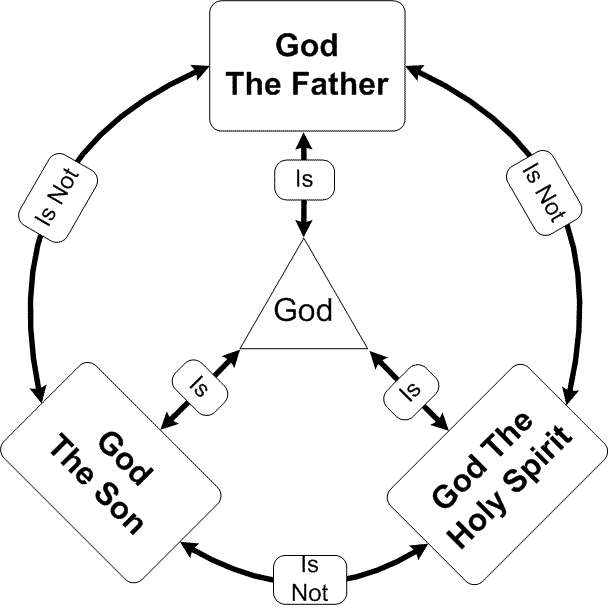
- God is an ultimate mystery whom our minds cannot comprehend, beyond all understanding; He is still with us now
Anthropology – Role of Human Beings
- Human beings are created in the image and likeness of God
- We have intelligence, will, and freedom
- Image – comes from the Hebrew word tselem meaning “direct resemblance;” this is how we are most similar to God (our soul)
- Likeness – comes from the Hebrew word demuth meaning “made like;” this is how we are unique beings (we have a body; God the Father does not)
- God, however, intended to become flesh to save humanity from the consequences of sin in the event that they freely chose against Him
- This is why Satan and his angels chose to leave God
- God, however, intended to become flesh to save humanity from the consequences of sin in the event that they freely chose against Him
- Human beings are hylomorphic (body + soul)
- Hylomorphic = Matter + Form = Material (Spiritual) + Formal (Corporeal) – Really interesting side note: Catholic sacraments have form + matter as well
- Human beings are inherently good, but they are weakened by original sin, and thus subject to temptation by the evils in this world
- Original sin is the cause of the “human condition,” inherited in a metaphoric sense by Adam and Eve’s choice to disobey God
“Although it is proper to each individual, original sin does not have the character of a personal fault in any of Adam’s descendants. It is a deprivation of original holiness and justice, but human nature has not been totally corrupted: it is wounded in the natural powers proper to it, subject to ignorance, suffering and the dominion of death, and inclined to sin – an inclination to evil that is called concupiscence”
The Catechism of the Catholic Church 405
- The purpose for all humans in life is to live a virtuous life, and to not only get to heaven, but bring others along with us through the example we led and those we prayed for and brought to faith
Soteriology – Salvation
- Salvation is through the grace of God, justified by faith and works
- Because of free will, people can choose to not commit acts of love
- Unlike Protestantism, Works hold great moral worth, and play an important role in salvation
- Baptism is necessary in reinstate the grace of God lost due to original, it washes away all sin, and allows one’s soul to be cleansed to reach a state of perfection ready for heaven
- What about Infants who die before being baptized?
- Limbo? or Baptism by another form?
- Can non-Christians be saved? (Yes, See Catechism 839-848)
Eschatology – the End of Times
- Catholics believe in the second-coming of Christ
- Catholics believed souls are judged immediately after death, in which one enters heaven, hell, or purgatory depending on the type of sins remnant on once’s soul
- Mortal Sin – these sins must meet 3 criteria: grave matter, full-consent, full-knowledge; they separate one from God’s grace
- Venial Sin – a sin of less gravity, or a sin that does not meet all 3 criteria; does not remove one from a state of grace, but still warrants time in Purgatory (which can be lessened with indulgences)
- They believe in the resurrection of the body after the final judgement, where one’s souls will reunite with resurrected bodies for all eternity in a sin-free state in heaven, or separated from God, in hell
Sacraments and Rituals

A sacrament is an outward sign of an inward (invisible) grace that is instituted by Christ that we may freely choose to receive. All sacraments in the Catholic Church have form and matter, and they require proper intent of those administering the sacrament.
Sacraments of Initiation
Baptism
Form: “I baptize you in the Name of the Father, and of the Son, and of the Holy Spirit.” | Matter: Water (Immersion, Infusion, or Sprinkling)
Baptism brings sanctifying grace, the grace necessary for salvation and a spiritual life, opening one’s soul to absorbing God’s infinite and unchanging love. It also brings additional graces to allow us to confirm and strengthen the soul’s spiritual needs at particular stages in life through virtues like faith, hope, and charity. Baptism brings new-birth through the power of the Holy Spirit, cleansing us from original sin and all personal sins; however, temporal consequences of sin like suffering and death, or the inclination to sin, known as concupiscence, remain. Catholics practice both infant and adult baptisms by the pouring of water, sprinkling of water, or immersion (often during Easter Vigils for new members). Individuals only need to be baptized once in-life in the name of the Trinity, which means that some Christian converts to Catholicism do not need to be re-baptized when they join the Church.
Who can perform baptisms?
1256 The ordinary ministers of Baptism are the bishop and priest and, in the Latin Church, also the deacon. In case of necessity, anyone, even a non-baptized person, with the required intention, can baptize, by using the Trinitarian baptismal formula. The intention required is to will to do what the Church does when she baptizes. The Church finds the reason for this possibility in the universal saving will of God and the necessity of Baptism for salvation.
The Catechism of the Catholic Church
All those who are baptized belong to the Mystical Body of Christ (MBOC), which sacramentally bonds those who are on Earth, in heaven, or in purgatory.
Baptism also gives a special “mark” on the soul, which allows one to absorb the graces in the other 6 sacraments and to participate in the Mass. It is a permanent quality that God, the saints, and the angels are all able to see, known as an indelible spiritual mark.
Can those who were not baptized by water (i.e other religions & unborn children) be saved?
In short, the Catholic teaching is yes, if those had not come to a place of reason. In addition to sacramental baptism by water, the Church teaches that one can be baptized by baptized by desire, which is not a sacrament, but it can confer sanctifying grace as long as one has an implicit desire for true baptism and makes an act of perfect love of God, based on faith with sincere sorrow for one’s sins. This is for those who have not truly heard and contemplated the teachings of the Gospel, but not for those who have downright rejected the Church’s teachings.
The Church also teaches that one can be baptized by blood, which encompasses those who have lost their lives for the faith without being baptized, such the catechumens in the early Church who intended to be baptized, but were killed.
As for the unborn, the Church believes that their fate is in God’s merciful hands. It does not have a clear understanding or universal teaching about their salvation. We really have no idea, so we leave it up to God, and we are to trust in His mercy.
Confirmation
Form: Bishop or designated Priest says, ” Be sealed with the Gift of the Holy Spirit“ | Matter: Holy Chrism (Blessed Oil) & the Laying on of hands by the Bishop or a designated priest
Confirmation strengthens the graces received during Baptism, as well as increasing our soul’s ability to absorb sanctifying grace. It also seals the 7 gifts of the Holy Spirit first received at Baptism and grants us sacramental graces we can draw from in order to life a good Christian example, “confirming”/completing our first Christian anointing.
Children may receive Confirmation at the age of discretion by the diocesan Bishop. Typically, the sacrament is administered at about age 13-15 for those who were baptized as infants, and it is followed by years of study of the Catholic faith. For those who convert to Catholicism at a later age, they receive all 3 sacraments of initiation (or 2 if previously baptized) during the Easter Vigil Mass after completion of an RCIA program through the Church.
Those who are studying to be confirmed are called Confirmation Candidates, and those who instruct them in the Catholic faith are called Catechumens. Each candidate will have a Catholic Confirmation sponsor who is in good-standing (See the 7 Precepts of the Church) with the Church during the preparation process.
The mark placed on our soul during Confirmation is one that gives us the power to profess the faith to those around us, without fear.
The Eucharist/Holy Communion
Form: Priest: the prayer of consecration during the Mass | Matter: Unleavened Bread and Grape Wine
The word Eucharist means “thanksgiving,” and it is a celebration of the rite instituted by Christ during the Last Supper, recalling the (Passion, life, death, resurrection, and eventual second-coming) of Christ. Each time one receives Holy Communion, one receives additional sacramental graces that strengthen our soul with God’s sanctifying grace, including growth in supernatural charity (love of God and neighbor). It has even been likened to “food for the soul,” because of its ability to fuel our souls with greater desire and capacity to love God. Receiving Communion is reserved for baptized individuals who profess the Catholic faith and who are in the state of grace, which means one has not failed to confess a mortal sin in the sacrament of Reconciliation. Reception of the Eucharist is so powerful that it will forgive venial sins if the penitent is truly sorry. Denying outside Christian denominations Communion is not out of elitism, but due to a differing in understanding of Christ’s real presence and the forgiveness of sins. Catholics profess that they pray for the day when all Christians are able to share at our Communion table.
Catholics believe that the Eucharist truly is Jesus’ Body and Blood, not in just a spiritual, but also in a physical sense. This transformation of unleavened bread/wine into Jesus’ Body and Blood is often called the mystery of transubstantiation, meaning across (trans) essence (substantia). The Church teaches that the Eucharist’s essence, meaning the “nature of reality” is truly Jesus, even though we only appear to see/taste bread and wine. What our senses perceive are known as “accidents,” or the apparent qualities of the bread/wine, but not the Blessed Sacrament itself, which is Jesus. (I know this is a lot of Church doctrine that can seem really overwhelming and confusing. Read it a few times, and some of the articles I linked to try to wrap your mind around this philosophy, but don’t worry if you can’t right now. That’s why it’s a Sacred Mystery).
Communion is celebrated during every Mass, which is a little bit more than just a Catholic worship service; in fact, the Mass is highly structured, with 2 parts (Liturgy of the Word and Liturgy of the Eucharist), whose readings cycle throughout the years but are identical in every celebration, each day, week, in every language, around the world in the Catholic Church.
See also: the 4th Cup by Scott Hahn on a Historical Approach toward the Eucharist & Eucharistic miracle in Poland, 2008
Sacraments of Healing
Reconciliation/Penance/Confession
Form: Priest: God’s Prayer of Absolution | Matter: Sins; Contrition and confession; priestly words of absolution
The sacrament of Confession is one that allows Catholics to return to a state of grace after offending God through thoughts, words, and/or actions. Catholics believe that there is no sin that is unforgivable. The penitent (person going to Reconciliation) confesses ones sins to God through a priest, who administers the prayer of absolution, which takes away one’s eternal punishment as long as one is truly sorry. There are two types of sorrow, or contrition, which are perfect and imperfect contrition. Perfect contrition is when one is sorry for sins out of love for God and having offended Him; imperfect contrition, or attrition, is when one is sorry for sins out of fear of eternal damnation. Both are good, and workings of the Holy Spirit; in both scenarios, one’s sins will be forgiven by God. Nonetheless, Catholics are called to strive for perfect contrition.
It is recommended that individuals make an Examination of Conscience before going to Confession, in which one reflects on one’s own shortcomings to live according to Christ’s teachings. Only mortal sins need to be confessed, but the individual will receive extra graces confessing venial sins as well. Practicing Catholics are required to go to Confession at least once per year. Before saying the prayer of absolution, the priest will assign a Penance to the penitent, which can be either a prayer or action to help lead an individual back onto the right path in life. The penitent will make an Act of Contrition, and then receive absolution for all sins (even those that were forgotten)
Anointing of the Sick
Form: Prayer of the Priest over the sick person for the grace of the Holy Spirit and the forgiveness of sins |Matter: Anointing with Holy Oil and Imposition of Hands
Anointing of the Sick used to be called Extreme Unction in the early days of the Church when the sacrament was explicitly used in times of near death or extenuating circumstances. Today, the sacrament can be received on one’s death bed, when one’s conditions of illness are not known, or even before surgery. It is a prayer of healing, administered by a priest who will anoint either an individual or to a group of persons with oil, followed by a special prayer and his laying of hands. This sacrament can be received more than once, and there is no age requirement. However, it is a sacrament for the living, and it cannot be offered to the dead. It involves liturgy, the Eucharist, and it is often followed by Confession.
Sacraments of Vocation/Service of Communion
Holy Matrimony
Form: The couple (one man and one woman): The I do’s, by which both spouses indicate their mutual consent to the marriage covenant. |Matter: Mutual Consent and Covenant to live together as husband and wife after the consummation of the Marriage
Unlike Protestant branches, Holy Matrimony is viewed by the Catholic Church as far more than just a blessed union or legal contract. It is a sacramental covenant between one baptized man and one baptized woman. The marriage should be celebrated in a Church, unless special permission is given by the Bishop to hold it elsewhere. For two baptized Catholics, this sacrament is often shared in a Nuptial Mass, which has special readings and prayers for marriage. Now, the priest or deacon is simply a witness of the Church; the true ministers of the sacrament are the bride and groom. A valid marriage within the Catholic Church requires both parties to be baptized, or dispensation from the Bishop if one is not.
Any couple seeking to be married in the Catholic Church must speak with the priest and go through a diocesan marriage-preparation program. Couples with only 1 Catholic partner (and no previous marriages that have not been annulled) can be married civilly or in a non-Catholic wedding ceremony; however, a convalidation ceremony is necessary for the Catholic Church to recognize such marriages. Convalidation is not just a “blessing” for an existing union involving a Catholic, but the freely exchanging of vows in front of a Catholic Church witness in accordance with the code of cannon law.
In a sacramental marriage between 2 baptized persons, the bride and groom receive graces necessary to:
1641: “to help one another to attain holiness in their married life and in welcoming and educating their children.”
The Catechism of the Catholic Church
In order to consummate a sacramental marriage, the words of wedding vows take flesh in the form of sexual union that is free (choosing to love one another without pressure and who is not previously married without annulment), total (not with-holding), faithful (exclusive), and fruitful (open to children).
The Church upholds the validity of marriages outside of the Catholic Church (such as a Non-Christian marrying a Christian, civil marriages, Jewish marriages, etc.) until the contrary is proven; however, these marriages are not sacramental. A valid marriage must include (1) single spouses; (2) freely given, mutual consent; (3) intention to marry for life, to be faithful to one another and be open to children; and (4) consent given in the presence of two witnesses and before a properly authorized Church minister.
The Catholic Church does not believe in divorce. Marriage is a life-long covenant. However, the Church does have an annulment process for those who believe their marriage is invalid, falling short of any of the above requirements. It is not a “Catholic divorce,” but rather an acknowledgement that the sacrament never took place, thus the couple was never truly married.
“Divorced”/legally-separated Catholics can only re-marry if their previous marriages were annulled. A civil divorce without an annulment, followed by re-marriage is not permitted by the Church, even if one of the spouses isn’t Catholic. Those in this situation are still called to live Christian lives and teach the faith to their children, but they are not allowed to receive the Eucharist because they are still married to their previous spouse in the eyes of the Church and may be in an occasion of serious sin. The same goes for those who had previous marriages but are wanting to convert to Catholicism. The very first marriage is considered a valid marriage until investigated by the Church in a tribunal process, and it must still receive an annulment before a couple is able to join the Catholic Church and be married sacramentally.
Holy Orders
Form: The Bishop’s “specific consecratory prayer” |Matter: Laying on of the Bishop’s hands with the prayer, chrism oil
The sacrament of Holy Orders, stems from the succession of the 12 apostles. The men who receive this sacrament receive the permanent spiritual mark, character, which represents Jesus’ presence in the Church. Thus, once a priest, always a priest. There are 3-levels of participating in this sacrament: bishop, priest, and deacon. The bishops receive the fullness of this sacrament, for they have the sole authority to offer all 7 sacraments. Bishops are previous priests (can celebrate 5 sacraments), which were previously deacons (can celebrate 2 sacraments). Priests receive the Sacrament of Holy Orders in the Rite of Ordination:
“The bishop lays his hands on the head of the candidate and says a prayer asking for the outpouring of the Holy Spirit. In one part of the rite, the candidate lies in front of the altar while the Litany of the Saints is sung or recited. In another part of the rite, a priest’s hands are anointed with chrism. In the rite for a bishop, the new bishop’s head is anointed.”
Loyola Press
Men who receive the sacrament must undergo years of theological and scriptural training through Seminary. It requires a vocational discernment process as well. They are called to live chaste lives and bear witness to the faith.
Rituals
Prayer – In the Catholic Church, there are many different types and forms of prayer, which is essentially just conversation with God. It can be through song, through our actions, through our thoughts, or through our words; as long as one offers it to God, it’s a prayer. It doesn’t matter how long, how big, or how small (See Conversation with God?)
- Types of prayer:
- Adoration – spending time adoring God
- Catholics may choose to do this in front of the Blessed Sacrament during Eucharistic Adoration, in which the Body of Christ is exposed in a sacred space
- Contrition – prayer of sorrow, asking God for the forgiveness of sins
- Thanksgiving – Thanking God for everything in life
- Petition – bringing our requests before God for ourselves, our loved ones, and even our enemies
- Supplication (Intercession) – asking those in heaven to pray for us and those in our lives
- Adoration – spending time adoring God
- Expressions of prayer:
- Meditative – prayerful reflection on the mysteries of the Christian life
- Vocal – using our words mentally or vocally to reflect the inner desires in our hearts
- Contemplative – silent love, fixed on Jesus
- Popular Formal Prayers:
- Prayer before meals
- The Our Father (Lord’s Prayer)
- Hail Mary
- Apostle’s Creed
- Prayer to the Holy Spirit
- The Rosary
- Prayer to St. Michael
- Guardian Angel Prayer
- The Divine Mercy Chaplet
- The Angelus
- Liturgy of the Hours
Almsgiving – This means donating money or goods to the poor and performing acts of charity
Fasting – Catholics fast (no snacks, and only light meals) and abstain from meat during Fridays in Lent, as well as Ash Wednesday, in preparation of the death and resurrection of Christ in the Easter season.
Church Leadership
There is a particular hierarchy to the Catholic Church. The Pope is the Head of the Church and direct successor to St. Peter, one of Jesus’ apostles and closest friends who also happened to be the very first pope. Under the pope are cardinals, archbishops, bishops, priests, and deacons, each with unique roles.

The Pope is officially the Bishop of Rome. The lineage of the papacy can be traced for centuries. Cardinals are specific priests that are responsible for electing a new pope and overseeing the practice of faith. Bishops are selected by a very complicated process that I won’t go into, but they are essentially responsible for assisting priests and being witnesses of Christ; they will administer the sacraments, specifically Confirmation and Ordination, to their prepared diocesan members and deacons. A diocese is a specific area that a bishop in kind of “in charge” of looking after; it usually will mirror county borders, but it doesn’t have to. Each diocese is filled with multiple priests, which are ordained after a very lengthy discernment and scholarly process. Each priest may have his own parish to preach and administer the sacraments to. There are many different orders of priests, and thus, not all priests are simply parish priests; some are monks, others are chaplains, etc. All priests must be male. (See Why can’t women be priests?)
There are also deacons, which can either be temporary or transitional. Deacons can assist the priest during Mass, but they are unable to celebrate Mass or consecrate the Eucharist. Transitional deacons are those who are studying to become priests and have reached a certain level of study in Theology. Permanent deacons are often former lay members, but they are not studying to become priests. Permanent deacons may be married, but only if they were before becoming a deacon. Transitional deacons and priests, however, may not marry. Their bride is the Church. (Although, some former pastors who converted to Catholicism and were previously married may be ordained with special permission from Rome).
Role of Mary and the Saints
Mary is the virgin mother of God. The Catholic Church teaches that she was born without sin and therefore conceived in her mother’s womb without sin (The Immaculate Conception). Catholics also believe that Mary was taken body and soul into heaven at the end of her life (The Assumption). They do not believe that she ascended into heaven by her own power, but that God raised her into heaven after her death.
Contrary to popular belief, Catholics do not worship Mary. Instead, they honor her, venerate her, and they ask for her intercession, a form of prayer. Some even consecrate their lives to Jesus through her. Catholics still uphold the teaching as Jesus as the sole mediator. Mary is the mother of God, and is currently in heaven, able to hear our prayers and offer them to God.
Mary is known to have revealed herself to multiple saints throughout time. Here are some of the major locations/names of Marian appearances and apparitions deemed “worthy of belief:”
- Our Lady of Guadalupe (1531)
- Our Lady of Rue du Bac, Paris, France (1830) – The Miraculous Medal
- Our Lady of Lourdes (1858) – recent confirmed miracle
- Our Lady of Fatima (1917)
- Our Lady of Kibeho, Rwanda (1981)
Catholics believe in the Communion of Saints, which includes all believers in Christ, united in truth and love in heaven, on earth, and in purgatory. It is a spiritual binding. So, just like one may ask a friend on Earth to pray for him, Catholics ask those in heaven to pray for them and their loved ones because they believe the saints and angels in heaven offer God their prayers, too. They do not pray to saints, but rather, with them, or they ask the saints to intercede for them on their behalf.
Saints are holy persons who lived model Christ-like lives. There are “saints,” which include all those in heaven, as well as “Saints,” which are those that the Catholic Church has officially canonized. Saints are formally recognized by the Catholic Church when they have performed at least 2 confirmed miracles after their death. Validation of these miracles may take a significant amount of time, so canonization can be a lengthy process. It is important to remember that Saints are human, sinners, and most of them suffered often during their lives.
Here’s a list of some of the most famous Saints:
- St. Padre Pio – bore the stigmata and could bilocate
- St. John Vianney – healer, gift of tears
- St. Teresa of Calcutta – served God in the poorest of the poor
- St. Hildegard – gift of prophecy, visions
- St. Joseph of Cupertino – could levitate
- St Anthony of Padua – patron of lost things, incorruptible tongue
- Blessed Alexandrina da Costa – survived on the Eucharist alone for 13 years
- St. Charbel, St Bernadette – incorruptibles
- Great St. Benedict – walked on water, resurrected the dead
- St. Denis – carried his own decapitated head around
- Brigit (or Brigid) of Kildare
Ethics
Simply put, Catholics believe in objective morality, as opposed to letting humans create morals based upon what they “feel” should be right or wrong. Catholics follow the 10 Commandments from the Old Testament, as well as Jesus’ greatest commands, to love God and thy neighbor. Any word, thought, or action that violates this love is sinful.
“So always treat others as you would like them to treat you; that is the meaning of the Law and the Prophets”
Matthew 7:12
See a detailed Examination of Conscience according to the 10 Commandments for a detailed list of examples of these sins. (I also really like this one because it explicitly lists some mortal and venial sins)
Sacred Text and Writings
- The Bible + Commentaries
- Old (Torah) + New Testament (Jesus’ New Covanent)
- Old Testament books ordered in a way that shows the fulfillment of Christ’s coming (not chronologically)

- The Catechism of the Catholic Church – contains Catholic Tradition and the Church’s official teachings
Really Interesting things to Learn more about/Explore:
- Nuns and Sisters
- JRR Tolkien helped convert C.S. Lewis from atheism to Christianity, the life of Tolkien as a devout Catholic
- Jesus’ Blood Type: AB+ (universal receiver)
- Gifts of the Holy Spirit – in real life
- Liturgical Seasons
- Holy Days of Obligation
- Theology of the Body
- Eucharistic Miracles, recent ones, of the world
- Catholic Conversion Stories, everyday stories, whyimcatholic.com
A life-long Conversion Story
Want to Learn More about Catholicism, but don’t know where to begin?
- Read the Catechism (not like a novel, but as a resource for specific questions)
- Read some of the writings of Church Fathers
- Check-out a Newman Center or Focus Ministry
- Binge-Watch some of my recommended You-Tube Channels
- United States Conference of Catholic Bishops (USCCB)
- Aquinas, T. (1485). Summa Theologica.
- Laudate: The Catholic App
- Listen to testimonies of faith… ask people about why they believe!
- Example: Dr. Holly Ordway, former atheist professor who converted through literature
- Not God’s Type: An Atheist Academic Lays Down Her Arms (Ordway, 2014)
- From Islam to Christ: One Woman’s Path through the Riddles of God by Derya Little
- Go talk to a Catholic Priest 🙂
My personal favorite blogs and video channels:
- Ascension Presents: Jackie Angel & Fr. Mike Schmitz
- Patrick Collins Show
- Matthew Kelly & Dynamic Catholic
- The Thomistic Institute – for students, academics, and theologians
- Busted Halo
- Life Teen
- Bishop Robert Barron’s Word on Fire
- Sr. Miriam James Heidland (@onegroovynun)
- Leah Darrow (@leahdarrow)
- Jason Evert & The Chastity Project
- Sr. Theresa Aletheia (@pursuedbytruth) – former atheist
Additional Reading List:
- Dr. Scott Hahn
- Apologia Pro Vita Sua by John Henry Newman
- How To Find Your Soulmate Without Losing Your Soul by Jason Evert
- The Light of Christ: An Introduction to Catholicism by Fr. Thomas Joseph White
- Five Proofs of the Existence of God by Edward Feser
- The Screwtape Letters by C.S. Lewis
- Theology of the Body for Beginners by Christopher West
- Fatima in Lucia’s Own Words by Sister Lucia
- The Shape of Catholic Theology: An Introduction to Its Sources, Principles, and History (Liturgical Press, 1991) by Aidan Nichols
- The Encyclicals of John Paul II: An Introduction and Commentary(Rowman & Littlefield Publishers, 2016) by Richard A. Spinello
- A Defense of Theism in Modernity: A Longitudinal Review
Here’s some Catholic memes that aren’t offensive to Catholics:


 LG❥
LG❥


 Pursuit of Truth
Leave a comment